



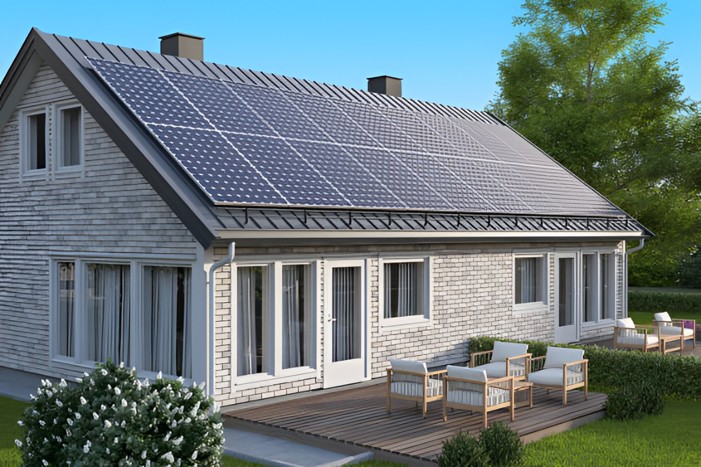
Solar Panels for North-Facing Roofs in Melbourne
A north-facing roof is the single best asset a Melbourne home can have when going solar. Because Australia sits in the Southern Hemisphere, north-facing panels capture sunlight for the longest portion of every day and deliver the highest annual energy output of any orientation. Ramselec Solar explains what that means for your home.
Table of Contents
Why North-Facing Roofs Are Ideal for Solar in Australia
The Right Tilt Angle for a North-Facing Melbourne Roof
How Much Energy Can a North-Facing Melbourne System Produce?
What Happens When Your North-Facing Roof Has Shade?
Combining North-Facing Panels With East or West Roof Faces
Does Battery Storage Change the Calculus for North-Facing Roofs?
Key Takeaways
North-facing panels produce up to 99% of maximum possible output in Melbourne.
The ideal tilt angle for Melbourne is 25 to 37 degrees.
Shade is the enemy of performance, not the panel direction.
East and west panels can supplement north installations effectively.
System design matters as much as orientation for long-term savings.
Why North-Facing Roofs Are Ideal for Solar in Australia
In the Northern Hemisphere, south-facing panels are the standard. In Australia, the opposite applies. Because we are in the Southern Hemisphere, the sun travels across the northern portion of the sky throughout the year. That means a north-facing roof receives more sunlight, for more hours, than any other orientation, allowing homeowners to maximise renewable energy generation from their solar investment.
The direction solar panels face is one of the most important factors in determining how much electricity a system produces. Panels facing the worst direction can generate around 28 per cent less energy than those facing the optimal direction. North-facing panels in Melbourne operate at close to 99 per cent of their maximum possible output, making them the clear first preference for any installation and helping households generate more clean, renewable energy throughout the year.
The science is straightforward. Solar panels generate the most electricity when sunlight strikes them as close to perpendicular as possible. Because Melbourne sits at approximately 37.8 degrees south latitude, north-facing panels receive direct midday sun from above throughout the year. This includes the shorter, lower-sun days of winter, when maintaining strong output is most valuable for reducing heating costs while increasing the amount of renewable energy available to power your home.
The Right Tilt Angle for a North-Facing Melbourne Roof
Orientation is only half of the equation. The angle at which panels are mounted also plays a meaningful role in how much energy they generate across the seasons.
For Melbourne, the generally accepted ideal tilt angle is between 25 and 37 degrees. This range reflects Melbourne's latitude and ensures panels capture strong output in both summer and winter without sacrificing either season. In practice, most Melbourne homes have roof pitches of between 15 and 25 degrees, which falls within an acceptable range. Even at a slightly suboptimal angle, the efficiency loss is minor.
If your roof pitch sits within 10 to 15 degrees either side of the ideal latitude angle, you will only lose between one and 1.5 per cent of maximum solar output. That is a negligible impact on the vast majority of Melbourne homes, meaning a standard north-facing roof is genuinely well-suited to solar without any tilt-frame modifications. While changing the tilt angle is rarely necessary, changing the solar panel orientation to maximise grid benefits may be worth considering in situations where households want to spread electricity generation more evenly throughout the day or better align production with changing energy tariffs and export conditions.
How Much Energy Can a North-Facing Melbourne System Produce?
Output varies across the year, but a well-sized north-facing system delivers strong results in every season. Melbourne's position as Australia's cloudiest capital city means some variability is unavoidable, but it does not undermine the case for solar. The continued growth of the Australian PV market has also led to significant improvements in panel efficiency and system design, allowing homeowners to generate more electricity even under Melbourne's variable weather conditions.
Here is what Melbourne homeowners with north-facing systems can typically expect:
Summer (December to February): Peak production. Long days, high sun intensity, and clear skies mean north-facing panels deliver their best output. A 6.6 kW system can generate 25 to 33 kWh on a good day.
Autumn (March to May): Strong production continues as days remain reasonably long. Feed-in tariff credits built up in summer offset any autumn reduction.
Winter (June to August): Output decreases due to shorter days and a lower sun angle. However, north-facing panels are better positioned than any other orientation to capture winter sun. A 6.6 kW system may generate 13 to 18 kWh per day.
Spring (September to November): Production ramps up as days lengthen. Spring is an excellent time to install, allowing the system to hit full stride heading into summer.
What Happens When Your North-Facing Roof Has Shade?
Shade is one of the most misunderstood factors in solar performance. Even a north-facing roof can underperform if part of it is shaded by a tree, neighbouring structure, or chimney during peak sun hours.
When panels are connected in a series string, shading on a single panel can drag down the output of the entire string. This is why a professional site assessment matters. An experienced installer evaluates not just the direction of your roof but also the shade profile at different times of day and across different seasons.
Solutions that minimise shade losses include:
Microinverters: Each panel operates independently, so shade on one panel does not reduce the output of others.
DC Optimisers: Attached to individual panels to maximise output from each one regardless of what is happening to adjacent panels.
Careful Panel Placement: Positioning panels on the unshaded portion of the north face while avoiding the areas affected by shade at peak times.
Trimming or Removing Shade Sources: Where a tree or structure causes significant shading, addressing the source directly is often the most cost-effective solution.
Correct installation and system design from the outset protects your investment and ensures strong output for decades.
Combining North-Facing Panels With East or West Roof Faces
Many Melbourne homes do not have sufficient north-facing roof space to accommodate the full system capacity they need. The good news is that east and west-facing panels can work well as supplements.
East-facing panels generate more electricity in the morning, which suits households with high morning energy use. West-facing panels produce stronger output in the afternoon and into the early evening, which aligns well with households that run air conditioning in hot Melbourne summers. East and west panels together produce a more consistent electricity output across the day compared to north-only systems, even if their total annual output is slightly lower.
An important installation note: if you add east or west panels to a north-facing string on the same inverter, you will lose performance. Panels facing different directions should each connect to their own inverter input or maximum power point tracker, so each group operates at its own optimal output without being held back by the other.
For a detailed look at how north-facing performance compares to other orientations across Australian capital cities, the SolarQuotes analysis of roof orientation and solar output across Australia provides a comprehensive breakdown of performance expectations for every direction, including south-facing roofs in Melbourne compared to ideally placed systems in other cities.
Does Battery Storage Change the Calculus for North-Facing Roofs?
Battery storage changes the value proposition of any solar system, but it is particularly powerful for north-facing installations. North-facing panels generate most of their electricity during midday when many households are at work or school and consumption is lower. Without a battery, a significant portion of that generation is exported to the grid at a relatively low feed-in tariff.
With a battery, that midday surplus is stored and used in the evening when energy demand peaks and grid electricity is most expensive. This significantly improves self-consumption and the financial return on your solar investment.
The federal Cheaper Home Batteries Program, available from July 2025, provides an upfront rebate of around 30 per cent on the cost of eligible battery systems. For Melbourne homeowners with north-facing systems, combining solar with battery storage is now more financially accessible than it has ever been. Get the most value from pairing your north-facing system with the right battery.
The hybrid solar options incorporate both generation and storage in a single integrated system.
Conclusion
A north-facing roof gives Melbourne homeowners the strongest possible starting point for solar. Combine that with the right tilt, quality equipment, and a shade-free installation, and your system will deliver strong returns for 25 years or more. Ready to find out what your north-facing roof can generate? Contact us today for a free quote.
FAQs:
Are north-facing roofs best for solar panels in Melbourne?
Yes. North-facing roofs produce close to 99 per cent of maximum solar output in Melbourne, outperforming all other orientations.
What tilt angle is best for north-facing solar panels in Melbourne?
An angle of 25 to 37 degrees is ideal for Melbourne. Most standard roof pitches fall within an acceptable range without modification.
How much power can a north-facing solar system generate in Melbourne?
A 6.6 kW system on a north-facing roof can generate 13 to 33 kWh per day depending on the season and weather conditions.
What if my north-facing roof is partially shaded?
Shading reduces output significantly. Microinverters or DC optimisers can isolate the impact of shading and protect overall system performance.
Can I add east or west panels to a north-facing system?
Yes. Additional panels on east or west faces complement north-facing panels and extend productive generation into morning and afternoon hours.
Does battery storage work well with north-facing solar?
Yes. Batteries store surplus midday generation from north-facing panels for use in the evening, significantly improving self-consumption and savings.


