



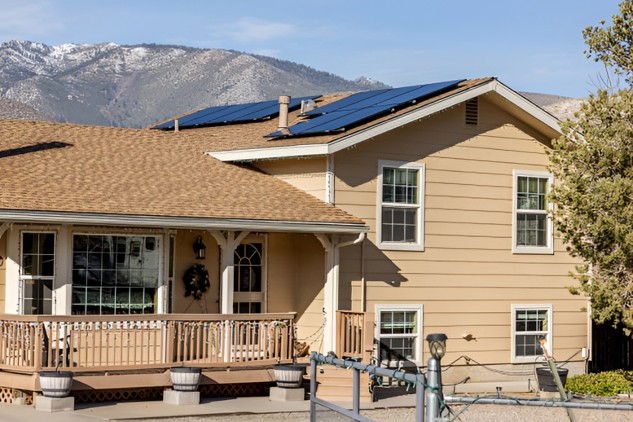
Residential Solar System for Split-Level Homes
Split-level homes throw a genuine curveball at standard solar design, multiple roof planes, different heights, and orientations that rarely all face the same direction. At Ramselec Solar, we design systems specifically around these layouts rather than forcing a one size fits all approach. Getting split-level solar right means treating each roof section on its own merits. Here's how proper design actually handles the complexity.
Table of Contents
Why Split-Level Roofs Genuinely Complicate Solar Design
Assessing Each Roof Plane on Its Own Terms
Tilt Frames and Correcting for Awkward Angles
Spreading Output Across Multiple Orientations
What the Research Says About Getting This Right
Where Battery Storage Genuinely Helps
Key Takeaways
Split-level roofs often have three or more distinct planes.
Tilt frames can correct for less than ideal roof angles.
Combining orientations can spread output across the day.
Batteries help smooth out uneven generation from mixed roof sections.
Each roof plane deserves individual assessment, not a blanket approach.
Why Split-Level Roofs Genuinely Complicate Solar Design
Split-level homes rarely offer the single, uniform roof plane that makes solar design straightforward. Different storeys, staggered rooflines, and varying pitch angles mean a system often needs to work across three or more genuinely distinct roof sections, each facing a different direction and catching sunlight differently throughout the day. The Australian Government's guidance on rooftop solar confirms that orientation and tilt angle both directly affect how much electricity a system produces annually, which matters considerably more when a home has several roof planes to account for rather than one obvious choice.
Assessing Each Roof Plane on Its Own Terms
Treating a split-level roof as a single design problem, rather than several smaller ones, is where a lot of underperforming systems go wrong. Each roof plane genuinely deserves its own assessment, accounting for its specific orientation, pitch, and any shading from adjacent roof sections or structures. A north facing upper level might perform beautifully, while a lower, east facing wing needs a completely different approach to make the most of the sun it actually receives. Considering future tree growth, nearby buildings, and seasonal sun angles also helps ensure the system continues delivering reliable performance over the long term, rather than only under ideal conditions.
Tilt Frames and Correcting for Awkward Angles
Tilt frames offer a genuine solution when a roof plane's natural pitch doesn't suit solar particularly well. RMIT's Solar Energy Application Laboratory has spent years researching exactly this kind of optimisation problem, examining how tilt angle, orientation, and system capacity interact to affect overall building integrated photovoltaic performance. Adjusting panel angle independently of the roof's actual slope lets installers correct for a less than ideal pitch, though it does add cost and complexity that's worth weighing against the performance gain. Professional modelling can estimate whether the additional energy generated over time justifies the investment, helping homeowners make informed decisions based on expected long-term performance and savings.
Spreading Output Across Multiple Orientations
Combining panels across multiple orientations isn't just a compromise forced by a difficult roof, it can genuinely work in a homeowner's favour. Spreading panels across east, north, and west facing sections smooths out generation across the day, rather than concentrating output entirely around midday the way a single north facing array does. For households drawing more power in the morning or evening, this spread can actually align better with real usage patterns than an idealised single orientation ever would.
What the Research Says About Getting This Right
Peer-reviewed research on rooftop solar yield confirms that suboptimal orientation and tilt genuinely reduce output, though the scale of that reduction depends heavily on how significantly a roof section deviates from ideal conditions. The research isn't Australia specific, but the underlying principles translate directly, a well designed system accounting for each roof plane's actual characteristics consistently outperforms one built around assumptions rather than genuine site data.
Where Battery Storage Genuinely Helps
Battery storage becomes particularly useful for split-level homes where generation across different roof sections doesn't line up neatly with household demand. At Ramselec Solar, Hybrid range pairs solar generation with storage specifically to smooth out this kind of unevenness, capturing excess output from a strong performing roof section and making it available later rather than losing it. This matters more for split-level homes than straightforward single orientation properties, since the generation curve itself tends to be less predictable.
Designing a System That Actually Fits Your Home
Designing a system that actually fits a split-level home starts with a genuine site assessment across every roof plane, not a generic package applied without much thought. Timing considerations worth factoring into any installation, split-level or otherwise. A customised design also considers future household energy needs, allowing the system to accommodate changing consumption patterns, electric vehicles, or battery storage upgrades without major modifications later.
A few things worth assessing on a split-level roof:
How many genuinely distinct roof planes does your home have?
Does each section face a different direction or pitch angle?
Would tilt frames improve performance on a poorly angled section?
Could combining orientations better match your actual usage pattern?
Would battery storage help smooth out uneven generation?
Conclusion
Split-level homes complicate solar design, but they don't rule it out, they just require a genuinely tailored approach rather than a generic system. Assessing each roof plane individually, and designing around what your home actually offers, delivers far better results than forcing a one size fits all layout. Ready to find out what your split-level home can support? Get in touch with our team and we'll design a system around your actual roof.
FAQs:
Can solar work well on a split-level home?
Yes, provided each roof plane is assessed individually and the system is designed around the actual layout.
Do all roof sections need to face the same direction?
No, combining different orientations can actually spread energy generation more evenly across the day.
What are tilt frames used for in solar installation?
Tilt frames adjust panel angle independently of the roof's slope, correcting for a less than ideal pitch.
Does a split-level roof need a bigger solar system?
Not necessarily, system size depends on household energy use rather than the number of roof planes alone.
Is battery storage more useful for split-level homes?
Often yes, since uneven generation across different roof sections can be smoothed out with stored energy.
How is a split-level roof properly assessed for solar?
A professional installer evaluates each roof plane's orientation, pitch, and shading before designing the system layout.


