



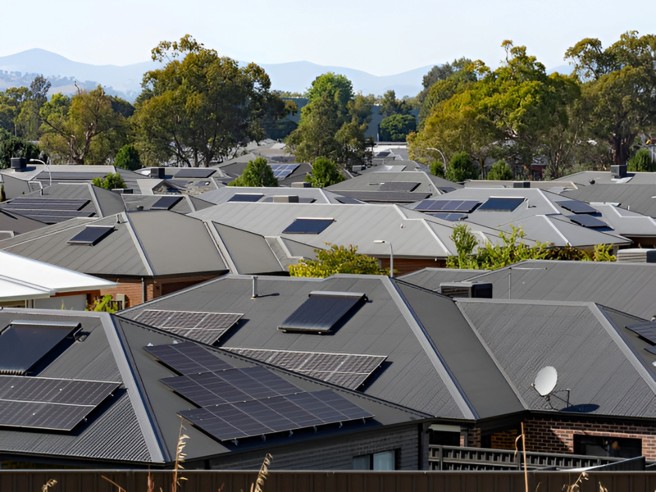
How Solar Panels Reduce Melbourne Energy Bills
Solar does not lower your bill by selling power back to the grid. It lowers your bill by stopping you from buying it. At Ramselec Solar, we design systems around that single principle, because the gap between what you pay for electricity and what you earn for exporting it has never been wider.
Table of Contents
Where the Saving Actually Comes From
The Feed In Tariff Is No Longer the Point
Design the System Around Your Day
What Melbourne Households Actually Save
The Evening Problem, and the Fix
Key Takeaways
Self consumption saves far more than exporting ever will.
Victoria abolished minimum feed in tariffs in July 2025.
Retail electricity costs roughly five times the export rate.
Running appliances at midday multiplies your savings.
Where the Saving Actually Comes From
Most people picture a meter spinning backwards. The reality is simpler and considerably more profitable. Every kilowatt hour your panels produce and your household consumes on the spot is a kilowatt hour you never purchase at retail price.
The arithmetic is stark. Australian Bureau of Statistics analysis shows retail electricity prices have doubled since 2009 to reach twenty nine cents per kilowatt hour, while the average feed in tariff halved over the same period to just six cents. Exporting a unit earns six cents. Using that same unit avoids paying twenty nine. The difference is where your bill disappears.
Victoria's own regulator states the position without ambiguity. The Essential Services Commission notes that solar customers benefit by avoiding retail tariffs, using the electricity their systems generate, and confirms that Victorian Default Offer retail prices ranged between roughly twenty six and thirty five cents per kilowatt hour depending on distribution zone.
The Feed In Tariff Is No Longer the Point
This changed materially and recently. The Victorian Government confirms that from 1 July 2025 electricity retailers set their own feed in tariff rates, with the previous regulated minimum removed entirely. Rates cannot fall below zero, but nothing obliges a retailer to pay meaningfully more.
Anyone still modelling a solar payback on generous export credits is working from a decade old assumption. Midday wholesale prices have collapsed precisely because so much solar now floods the grid at once. The value moved. It did not vanish, but it moved indoors.
Design the System Around Your Day
A system sized to your roof will export heavily at noon and earn little. A system sized to your consumption pattern, paired with sensible habits, does something rather different.
Shift these loads into daylight hours:
Dishwasher and washing machine cycles.
Hot water heating, ideally on a timer.
Pool pumps and filtration.
Electric vehicle charging where practical.
Pre cooling or pre heating the house before evening.
Sustainability Victoria highlights the hot water opportunity in particular, explaining that electric water heaters can act as a solar soak, making more effective use of the output of the photovoltaic system and generating greater energy savings by reducing what is exported. A timer costs almost nothing and converts wasted export into avoided purchase.
What Melbourne Households Actually Save
The figures hold up under scrutiny. Research from the UNSW School of Photovoltaic and Renewable Energy Engineering found that rooftop solar can deliver average annual household bill savings of $1,300. Across the country, the Bureau of Statistics calculates the household sector saved just over three billion dollars in a single year through rooftop generation.
Melbourne winters temper those returns, and any installer promising uniform savings through July is overselling. Yet the state's moderate climate cuts both ways. Cooling loads peak in summer, exactly when generation peaks, and that alignment is worth a great deal.
The Evening Problem, and the Fix
Solar generates when the sun shines. Households consume most heavily once everyone is home. That mismatch is the central limitation of panels alone.
Storage closes the gap by holding midday surplus until the evening peak, converting a six cent export into a twenty nine cent avoided purchase.
Electrification amplifies everything. Victorian Government guidance indicates that switching to solar can save a typical household more than $1,000 every year, and up to $1,400 with a battery. Replacing gas heating and hot water shifts load onto a supply you already generate for free.
Getting the Most From Your System
Panels alone do not guarantee a lower bill. Decisions do.
Review twelve months of interval data before sizing anything.
Compare retailers on import rates, not headline export rates.
Timer your hot water to run between ten and two.
Monitor generation and consumption, not just the bill.
Reassess once an electric vehicle or battery arrives.
Quality matters over twenty five years. Residential solar installations service at Ramselec Solar use Tier One components throughout, designed and overseen by a master electrician rather than a subcontracted crew.
Conclusion
Melbourne bills fall when generation meets consumption, not when surplus trickles into the grid for pennies. Size the system to your household, shift your loads into daylight, and the savings compound quietly for decades. To have your property assessed properly by an award winning master electrician, contact us for a free quote.
FAQs:
How much can solar panels save on Melbourne bills?
Research indicates average household savings near $1,300 annually, rising substantially when paired with battery storage.
Is exporting solar to the grid still worthwhile?
Marginally. Retailers pay roughly six cents per kilowatt hour, while retail electricity costs around twenty nine.
Does Victoria still set a minimum feed in tariff?
No. From 1 July 2025 retailers set their own rates, provided they remain above zero cents.
What is solar self consumption?
Using electricity your panels generate immediately, rather than exporting it, which avoids paying retail prices entirely.
When should I run appliances with solar panels?
Between roughly ten and two, when generation peaks. Timers on hot water systems work particularly well.
Will solar reduce my bill during Melbourne winter?
Yes, though less than summer. Generation falls with shorter days, so savings vary seasonally across the year.


